Bundles are a popular way for small sellers to stand out: a shampoo with a matching conditioner, three sizes of storage bags, a starter kit made from items you already stock. But a bundle that leaves your bench as "a few items in a bag" can reach the fulfillment center as three loose units with three different barcodes. Then it gets received wrong, sold wrong, or set aside.
Shipping small batches to Amazon FBA or Walmart WFS? Get a prep quote. No monthly minimum on FBA and WFS prep.
This guide covers the prep and labeling basics that keep a seller-made bundle together as one sellable unit from your box to the customer's door.
Bundle, multipack or case pack: know which one you have
Amazon separates two packaging ideas that often get confused:
- Individual products are units shipped in the same box but sold separately. They can differ in SKU, quantity and condition.
- Case-packed products are matching units (same SKU, same condition, same quantity per case), usually packed that way by the manufacturer.
A seller-made bundle or set is neither of these. It is several items that must be sold as one unit under one listing. Amazon's own prep guide says that if items aren't an official set but you're selling them as one unit, you should package them together and clearly mark the outside as a set.
Before you prep anything, confirm the listing really is a bundle listing. If the ASIN is for a single item, no amount of bagging will make it a set.
Rule 1: Make it physically one unit
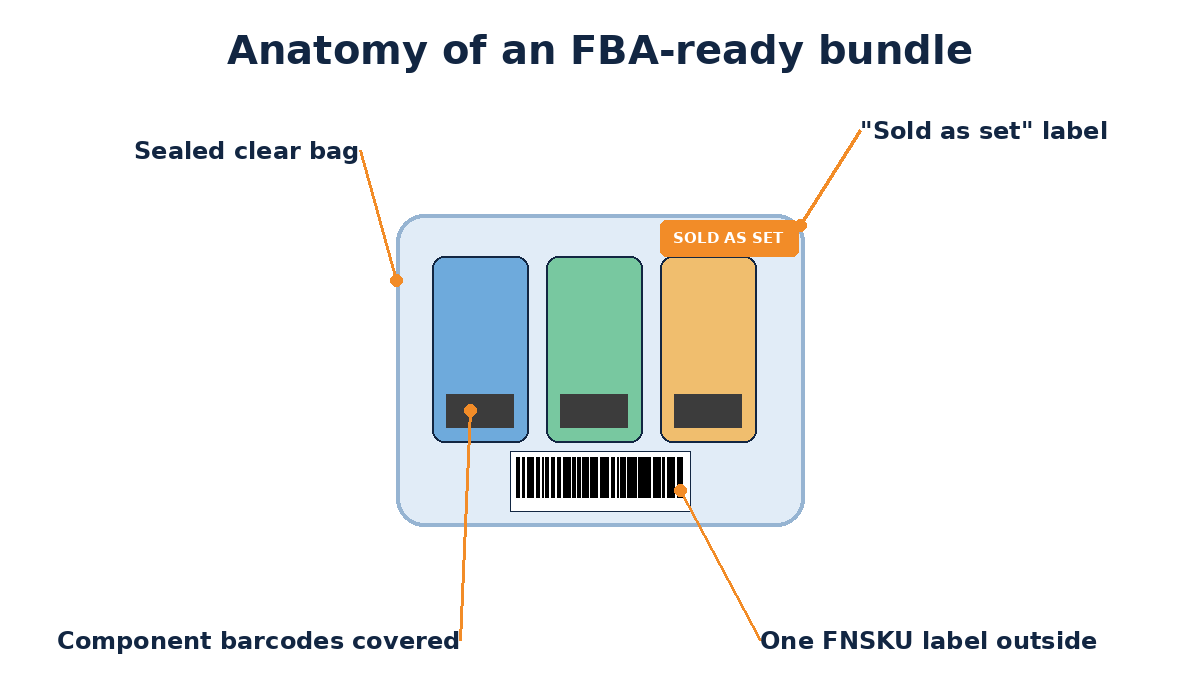
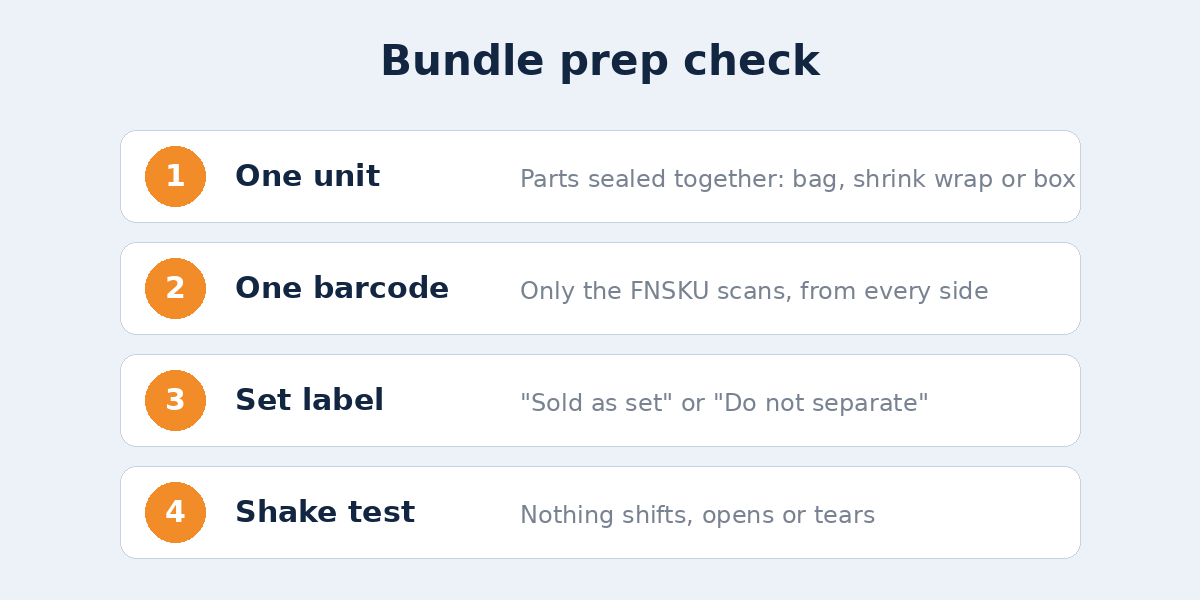
Every unit sent to FBA has to be contained in a single, secure package. For a bundle, that means the parts can't be able to slide apart in a carton or on a conveyor. Common ways to do this:
- A clear polybag sized to the bundle, fully sealed. The normal polybag rules still apply: the bag shouldn't extend more than about 3 inches past the product, and a suffocation warning is needed when the opening is larger than 5 inches.
- Shrink wrap that holds the parts tightly together.
- A box that holds every component, closed so nothing can fall out.
If any component is fragile, such as glass, ceramics or sharp items, it still needs bubble wrap or other protection inside the bundle. Bundling doesn't remove the prep a single item would need.
Quick shake test
Hold the finished bundle by one corner and shake it gently. If a part shifts out, a seam opens or the bag tears, it isn't ready for FBA.
Rule 2: Show one scannable barcode only
This is where most bundle problems start. Each part of your bundle probably carries its own manufacturer barcode (UPC or EAN). If a fulfillment center associate scans one of those instead of your bundle label, the unit can be received as the single item, not the set.
So:
- Cover every component barcode that can be seen from the outside. Use an opaque label or cover it in a way that can't be scanned. Barcodes visible through a clear bag count too.
- Put one FNSKU label on the outside of the bag, shrink wrap or box. It should be on a smooth, flat surface, not wrapped around a corner or curve.
- Check from every side. Turn the bundle over and look through the bag. If you can see any other barcode, cover it.
The aim is simple: whichever way the bundle is turned, the only thing a scanner can read is the bundle's FNSKU.
Rule 3: Label it as a set
Amazon's prep guidance asks you to clearly mark seller-made sets on the outside with a label such as:
- "Sold as set"
- "Ready to ship"
- "This is a set. Do not separate."
This label tells people at the fulfillment center not to split the package into its parts. Place it where it's easy to see, but don't cover the FNSKU label with it.
A five-step bundle routine
Bundle prep works best as the same routine every time:
- Match the listing. Confirm the bundle ASIN, the component count and the FNSKU before opening any stock.
- Count and stage the components for the full quantity, so you don't run short halfway through.
- Assemble and secure each bundle in a bag, shrink wrap or box, adding protective wrap for any fragile part.
- Cover component barcodes, apply the FNSKU and add the set label. Then do the turn-over check.
- Photograph a finished bundle from the front and back before it goes in the carton, so you have a record of how it left.
Common bundle mistakes to avoid
- Loose parts in the carton. Rubber bands and tape that can let go aren't a secure package.
- A clear bag with UPCs showing through. The bag is sealed, but the scanner still sees the wrong barcode.
- The FNSKU label under the set label, or wrapped over a seam where it won't scan.
- Mixed component versions. If one bundle has the old scent and the next has the new one, customers will notice.
- Skipping prep for a fragile piece because it's "inside a bundle."
The bottom line
A good bundle is boring to receive: one package, one barcode, one clear "do not separate" label. Get those three right and your set has a much better chance of being received and sold the way you listed it.
Rules change, so check Amazon's current prep and labeling requirements in Seller Central before a big bundle run.
Want help with a bundle run? PrepToShip does small-batch prep for sellers anywhere in the US and overseas sellers shipping into US FBA and WFS. We typically turn shipments around in 24–48 hours with photos at every step, and there's no monthly minimum on FBA and WFS prep. Labeling fees are waived on your first 100 units (add-ons billed normally). Start here.