A candle jar, a set of glass tumblers, a ceramic mug, a kitchen knife. They are great products for small sellers, and they are also the units most likely to be damaged, refused or thrown away when they reach an Amazon fulfillment center with the wrong prep.
Shipping small batches to Amazon FBA or Walmart WFS? Get a quote No monthly minimum on FBA and WFS prep.
This guide covers what Amazon asks for with fragile, glass and sharp items. It also covers the simple checks you can do at your bench before a small-parcel shipment leaves. As always, check the current prep guidance in Seller Central for your exact product, because Amazon updates these pages.
Why these items need extra care
Inventory sent to FBA gets handled many times: in the carrier network, at receiving, on conveyors and when it is picked and packed. A unit that would survive a gentle trip to a customer's door may not survive that. Amazon's prep guidance says non-compliant inventory can be refused at receiving, disposed of, or prepped by Amazon for a fee. So the prep happens before the box is sealed, not after.
Fragile and glass items: wrap it or box it
Amazon's prep guide treats glass, ceramics, china, picture frames, clocks, mirrors and other breakable items as fragile. The core requirements are:
- Protect the whole unit. Wrap it in bubble wrap or place it in a protective over-box. No breakable surface should be exposed.
- Pass a 3-foot drop test. The packaged unit should survive being dropped from 3 feet onto a hard surface without breaking.
- Keep the barcode scannable. The FNSKU (or other required barcode) must scan without anyone opening or unwrapping the unit.
How to run the drop test
Amazon's drop-test guidance describes five drops from 3 feet onto a hard floor, such as concrete: flat on the base, on the top, on the longest side, on the shortest side and on a corner. After all five, open the packaging and check for cracks, chips or loose pieces. If anything broke, add protection and test again.
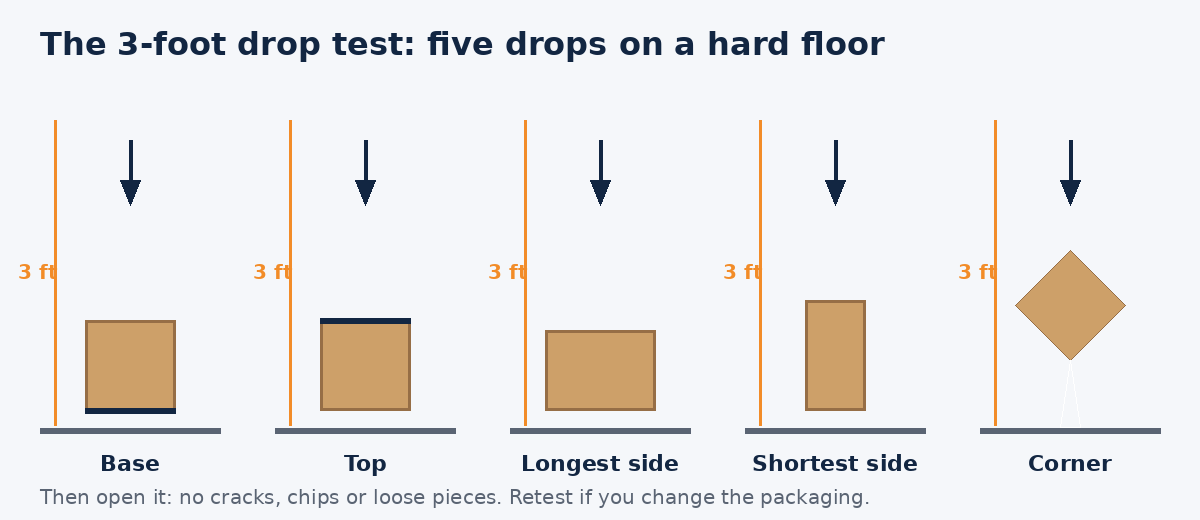
You don't need to test every unit in a shipment. Test one unit packed exactly the way the rest will be packed. If you change the bubble wrap, box size or fill, test again.
Practical tips for glass and ceramics
- Wrap pieces in a set one by one. Glasses or plates that touch each other inside a box can chip each other, even when the outside looks fine.
- Fill empty space. A mug that can slide inside its retail box can break on the corner drop. Add fill so nothing moves when you shake the unit.
- Over-box when bubble wrap isn't enough. Heavy or thin glass often does better in a snug over-box than in layers of wrap.
- Put the label on the outermost layer. If you over-box or bubble-wrap a unit, the FNSKU goes on the outside. Cover any other scannable barcodes underneath so the unit can't be scanned as the wrong product.
Sharp items: cut- and puncture-resistant packaging
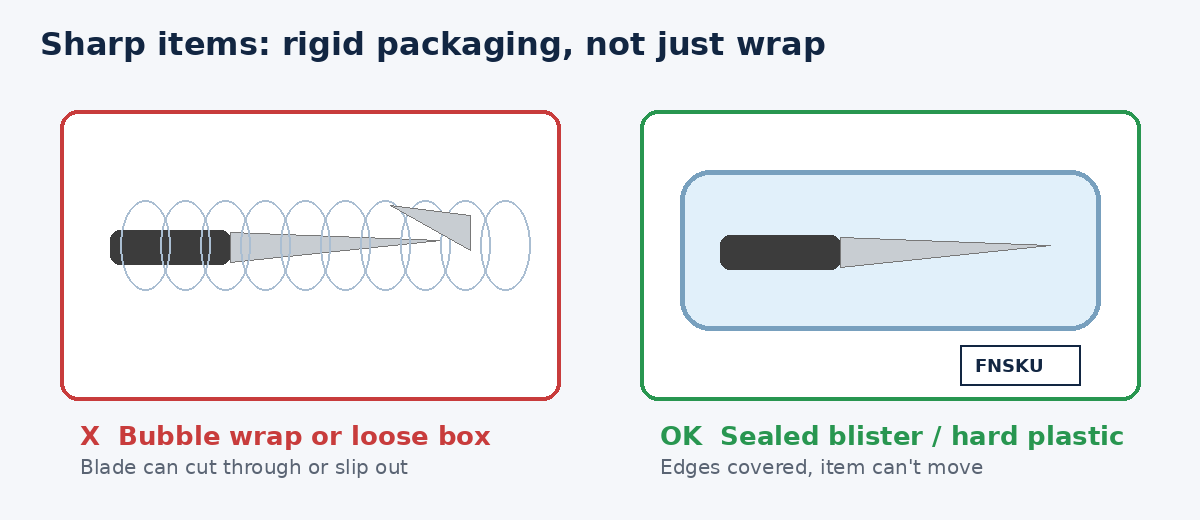
Sharp products include knives, scissors, cutting tools and anything with an exposed point or blade. Amazon updated its rules here. Effective April 14, 2025, Amazon said it no longer offers prep services for sharp products, and sellers must package all sharp products in secure, cut- and puncture-resistant packaging, such as hardened plastic or blister packs.
Bubble wrap or a loose box around a blade is no longer the standard. Amazon's announcement also said sharp products that don't meet the updated requirements on arrival will be disposed of immediately at the seller's expense and won't be eligible for reimbursement.
What to check before sharp items ship
- Every edge and point is covered by rigid packaging, not just wrap or tissue.
- The item can't move inside the pack. A blade that shifts can work its way through a weak seal.
- The packaging is sealed and secure. Blister packs and clamshells should be closed so they can't pop open.
- The barcode scans from outside without opening anything.
If a product's original retail packaging already meets these rules, you may only need labeling. If it arrives loose or in thin packaging, plan for rigid packaging before you create the shipment.
A quick bench checklist
Before you seal a carton with fragile, glass or sharp units:
- Identify which SKUs are fragile or sharp. Check Seller Central's prep guidance for each one.
- Pack one test unit exactly as the rest will be packed.
- Run the five-drop test on fragile units and inspect them.
- Confirm sharp edges are in rigid, cut- and puncture-resistant packaging.
- Shake each packed unit. Nothing should rattle or shift.
- Scan the FNSKU from the outside of the final packaging.
- Take photos of the packed units and the open carton before you seal it. They help if you ever need to show how a unit was prepped.
Where small shipments go wrong
Most fragile and sharp prep problems are simple. A barcode is hidden under bubble wrap. A set has pieces wrapped together. A knife is in its retail box but the box opens at one end. None of these take long to fix at the bench. They take much longer to fix once a shipment has been refused or disposed of.
Need help with fragile or sharp units?
If you'd rather not do the wrapping, testing and labeling yourself, PrepToShip handles small-batch prep for Amazon FBA and Walmart WFS sellers anywhere in the US and overseas. You get typically 24–48h turnaround and photos at every step, with no monthly minimum on FBA and WFS prep. On your first shipment, labeling fees are waived on the first 100 units (add-ons billed normally). Get a quote.
Know your cost before you ship
Small-batch Amazon FBA and Walmart WFS prep, with no monthly minimum on FBA and WFS prep.
Get a quote