Polybags and bubble wrap look like the easy part of FBA prep. You put the item in a bag, seal it, slap on a label and move on. In practice, bagging is one of the most common places small shipments go wrong, because a few specific rules decide whether a unit is accepted as-is or needs to be reworked.
Since January 1, 2026, Amazon no longer offers its own FBA prep and item-labeling services in the US, so this work has to be done before your inventory arrives, by you, your supplier or a prep partner. Here is what to check before a bagged or wrapped unit goes into the box.
When a unit needs a polybag
Amazon's prep guidance calls for bagging on products that could get dirty, damaged or separated during handling. Common examples include:
- Apparel, fabric and other textiles
- Plush and baby products
- Jewelry and other small items that could get lost
- Powders, pellets and granular products
- Items in perforated packaging or with loose parts
Your SKU's prep guidance in Seller Central is the final word. If it says a unit needs bagging, bag every unit of that SKU, not just the ones that look fragile.
The polybag rules, one by one
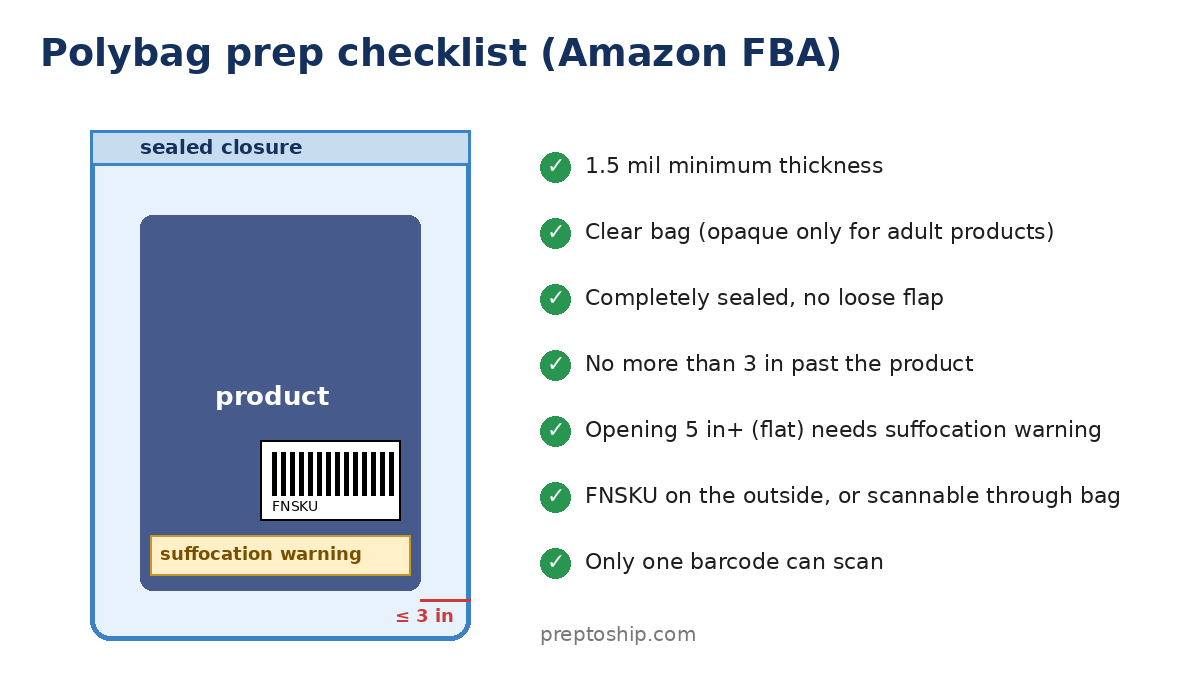
Amazon's bagging requirements boil down to a short list:
- Thickness: the bag must be at least 1.5 mil (thousandths of an inch). Very thin produce-style bags won't meet it.
- Transparent: the bag must be clear so the item can be identified. The exception is adult products, which must go in black or opaque bags or shrink wrap.
- Completely sealed: use a self-adhesive strip or tape so the bag is fully closed. A folded-over flap or a loose zip top isn't sealed.
- Right size: the bag shouldn't extend more than 3 inches beyond the product's dimensions, and you shouldn't force a product into a bag that's too small.
- Scannable barcode: the barcode must scan through the bag, or the FNSKU label goes on the outside of the bag.
The suffocation warning
Any bag with an opening of 5 inches or more, measured when the bag is flat, needs a suffocation warning, either printed on the bag or applied as a label. If your bag's opening is right at 5 inches, treat it as needing a warning.
The warning commonly quoted from Amazon's requirement reads: "WARNING: To avoid danger of suffocation, keep this plastic bag away from babies and children. Do not use this bag in cribs, beds, carriages or play pens. This bag is not a toy."
The text must be large enough to read for the bag's size. The minimum print size is set by the bag's length plus width: 10 point for small bags, rising to 14, 18 and 24 point as bags get larger. The simplest fix is to buy bags with the warning pre-printed, so you never have to think about it on the packing table.
Bubble wrap for fragile items
Glass, ceramics and other breakable items need protection that holds up through normal warehouse handling. Bubble wrap is one accepted way to do it. A few habits keep it clean:
- Cover the whole item. Wrap corners, edges and weak points like handles or spouts, not just the main body.
- Secure the wrap. Tape it so it can't slide off or unroll in the box.
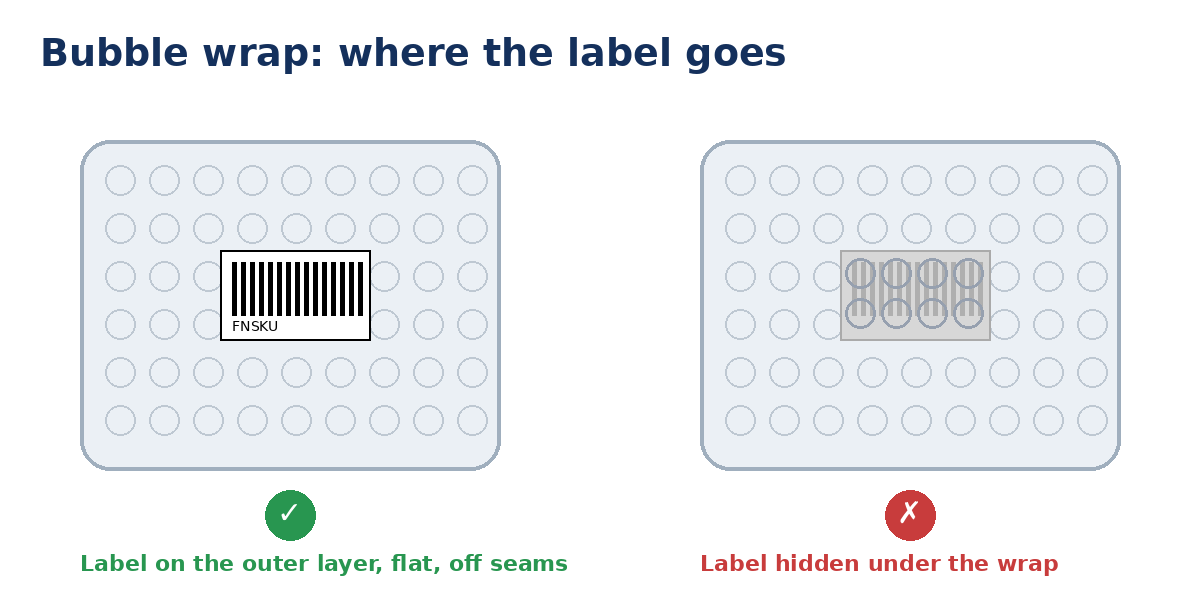
- Label the outside. Once wrapped, the original barcode is hidden, so the FNSKU goes on the outer layer of wrap.
- Check for movement. If the item shifts inside the wrap or a breakable section is exposed, re-wrap before labeling.
For very fragile items, wrapping alone may not be enough. Your SKU's prep guidance may also call for boxing, so check it rather than guessing.
Put the label on the final layer
Whether it's a bag or bubble wrap, the rule is the same: the barcode Amazon scans must be on, or clearly readable through, the outermost layer of the unit. Small details make the difference:
- Smooth the bag or wrap flat where the label goes.
- Keep the label off seams, folds and tape.
- If the SKU uses an Amazon barcode, make sure no manufacturer barcode can be scanned through a clear bag. Cover it or position the FNSKU label so only one barcode is readable.
- Don't cover the suffocation warning with the FNSKU label.
A quick bagging routine for small batches
For a batch of 20 to 200 units, a consistent routine beats speed:
- Check the SKU's prep guidance first and pick the bag size before you start.
- Test one unit. Bag it, seal it and measure the overhang and the opening.
- Bag and seal the whole batch, then label. Labeling last keeps the barcode on the outside.
- Scan a few finished units with a handheld or phone barcode app to confirm only the FNSKU reads.
- Photograph finished units so you have a record if a receiving question comes up later.
When to hand it off
Bagging, wrapping and labeling a few hundred units is tedious, and it's easy to get a detail wrong late in the day. If you'd rather spend that time sourcing, PrepToShip handles prep and labeling for small Amazon FBA and Walmart WFS shipments from Northern Virginia, with photos at every step: on arrival, after prep and labeling, and when your order is packed and shipped.
We typically turn small shipments around in 24–48 hours, there's no monthly minimum on FBA and WFS prep, and labeling fees are waived on your first 100 units (add-ons like bagging are billed at normal rates). If that helps, request a quote and tell us what you're sending.