If you already ship to Amazon FBA, Walmart Fulfillment Services (WFS) will feel familiar, but some Amazon habits cause problems at Walmart. The biggest one is the barcode on the unit.
This guide covers which item barcode to use, where the box labels go, and which items need extra prep. It's based on Walmart's Marketplace Learn guides and the WFS Routing and Packaging Guide (US, September 2026). Walmart updates that guide, so check the current version before a big send.
Item labels: UPC or GTIN, never FNSKU
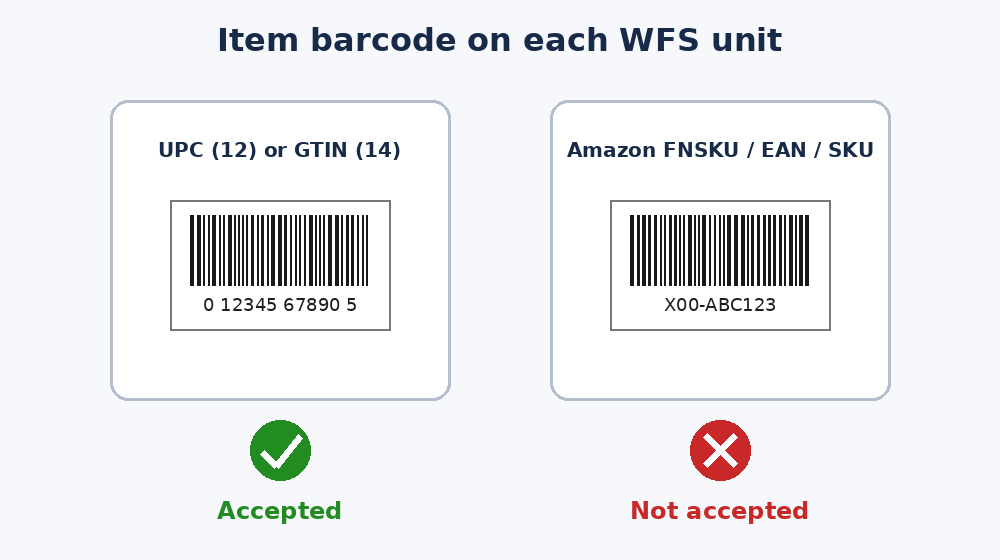
Every sellable unit needs a scannable barcode on its outermost packaging. Walmart accepts two kinds:
- UPC (12 digits)
- GTIN (14 digits)
Walmart says plainly that EAN, vendor SKU and FNSKU numbers are not acceptable barcodes or product identifiers. If your units still carry Amazon FNSKU stickers from an earlier FBA plan, cover them before they go to WFS.
A few more rules from the guide:
- One barcode per variant. Each size, color or other variant needs its own unique barcode. Walmart says variants without unique barcodes will not be received and may be returned to you at your expense.
- Scannable without opening anything. The barcode must scan without removing bags or tape. On a polybagged unit, the barcode needs to scan through the bag or sit on the outside of it.
- Cover old barcodes. Walmart requires you to cover old labels and barcodes, because conflicting barcodes cause confusion and delays at receiving.
- No other retailers' labels. Price tags, or any labels showing the item came from another retailer, should not be on the packaging.
- Units only, not the shipping box. Don't put the item barcode on the outer shipping box.
If a unit doesn't already have a correct, scannable barcode, you can print item labels in Seller Center. Go to Inventory, select the items, choose Print GTIN label, then pick the label size and quantity. Your own labels are fine too, as long as the correct barcode is on them. Walmart recommends printing at 300 DPI or higher.
Two other marks to check
- Country of origin. Every item needs a clear, permanent country-of-origin mark that's visible during casual handling. For clothing, a "Made in…" label counts. For shoes, the mark has to be on both shoes.
- Expiration dates. Walmart treats anything with a shelf life as perishable, including supplements, creams, soaps and cleaning products. These need a visible expiration or best-by date in MM-DD-YYYY, YY-MM-DD or YYYY-MM-DD format. If you only know the month, use the first day of that month. WFS does not accept items that need temperature control.
Box labels: the receiving label
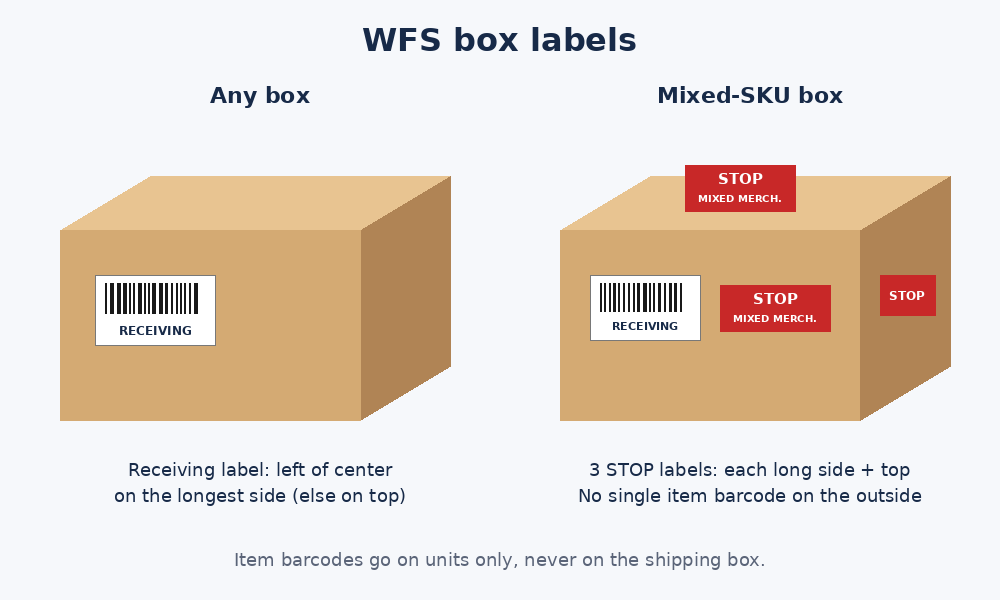
Each box needs a WFS receiving label from Shipping Plans → View plan in Seller Center. It isn't the carrier label. It shows your return address, the WFS ship-to address, the shipment ID and a shipment ID barcode or QR code.
Put it left of center on the longest side of the box. If that won't work, put it on the top.
Mixed-SKU boxes have two extra rules. First, don't show any single item barcode on the outside. Second, add three labels that read STOP | MIXED MERCHANDISE | RECEIVE AS BREAK PACK: one on each long side and one on top, with at least one near the receiving label.
Which items need extra prep
All items must arrive in a sealed or closed container, ready for sale. Some item types also have their own requirements:
- Liquids, pastes, gels and creams need leak-proof packaging, meaning a sealed opening, shrink-wrap or a polybag. Spray nozzles and triggers must be blocked or secured. If the packaging isn't leak-proof, Walmart says WFS will polybag the item and charge an unplanned prep fee.
- Fragile items such as glass, ceramics and electronics must be in a six-sided rigid box, so no part of the item is exposed.
- Sets must be packaged together, sealed so the pieces can't be separated, and labeled "Sold as set." Walmart's own Prep Services don't do this bundling, so it has to happen before shipping.
- Polybags with an opening of 5 inches or more need a suffocation warning. The bag must be fully sealed, and the barcode must scan through it or sit on the outside.
For dunnage, Walmart accepts foam, air pillows, bubble wrap and full sheets of paper. It does not accept Styrofoam, any packing peanuts (including biodegradable and cornstarch), crinkle wrap or shredded paper.
Inbound basics
- Ship only to the fulfillment centers in your shipping plan. If the plan assigns more than one, you have to ship to all of them, or use Walmart's Inventory Transfer Service to consolidate. Walmart says inventory sent to the wrong location is rerouted at your expense.
- Use the Walmart Preferred Carrier Program or your own carrier. If you use your own carrier, put the shipment ID (for example, 1234567WFA) in the carrier's reference field.
- Expect slower receiving in peak season. Receiving normally takes up to 2 business days after delivery, but up to 10 when items need unplanned prep or arrive October 1 to December 31.
Most costly WFS problems come down to a wrong or missing barcode, or unprepped liquids and sets. Each one can mean an unplanned prep fee, a delay or a return.
Need help with a small WFS shipment?
PrepToShip does small-batch prep and labeling for Walmart WFS and Amazon FBA, for sellers anywhere in the US and overseas. Turnaround is typically 24–48 hours, we send photos at every step, and there's no monthly minimum on FBA and WFS prep. Labeling fees are waived on your first 100 units (add-ons are billed normally). Start here.