Yes: liquids can be sent to an FBA prep center when they are sealed, bagged where needed and labeled to Amazon's current liquid prep guidance.
Shipping small batches to Amazon FBA or Walmart WFS? Get a quote No monthly minimum on FBA and WFS prep.
PrepToShip is a micro 3PL and prep center in Alexandria, VA, offering small-batch FBA and WFS prep in Northern Virginia, no monthly minimum on prep, typically 24–48 hour turnaround, photos at every step. This guide covers how Amazon asks you to prep liquids, plus a simple leak check you can do at the bench before a small-parcel shipment goes out. Amazon updates these pages, so always check the current prep guidance in Seller Central for your exact product before you ship.
Can I send liquids to an FBA prep center?
Yes. Lotions, oils, sauces and cleaners are some of the easiest products to get wrong at an Amazon fulfillment center. One loose cap can soak a carton and damage other units. A prep center can tape, bag, wrap and leak-check the batch before it goes to Amazon, so the units arrive prepped to the guidance for your product.
What Amazon asks for depends on the product. Amazon's liquid products page is the starting point. For example, it says no additional prep is needed for a liquid of 4.2 oz (125 mL) or less, unless the product is repeatedly damaged in transit or handling. Fragile containers such as glass or ceramic need bubble wrap, and may also need a cap seal if the bubble wrap does not stop leaks.
Do liquids need a cap seal?
Often, yes. Amazon's cap seal requirements apply to liquids, pastes, gels and creams. A cap seal (tape on or around the cap or lid) is required when the item:
- is 4.2 oz (125 mL) or more
- is not hazmat
- is not in a fragile container
- has a twist or screw top, clip-on top, flip top or hand pump
- does not have a secondary seal (also called a double seal)
The same page lists items that don't need a cap seal: roll-ons, non-fragile screw-top jars, metal cans or tins, mascara, and anything under 4.2 oz (125 mL).
How to apply a cap seal
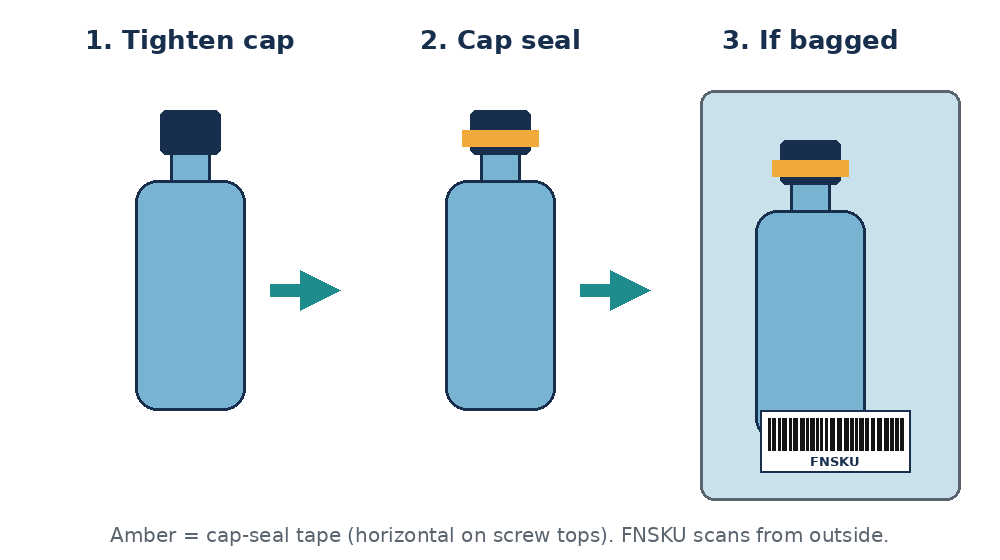
Amazon's cap seal instructions are specific about direction:
- Tighten the lid first. Tape over a loose cap doesn't fix it.
- Twist or screw tops: run the seal horizontally around the cap.
- Flip or clip tops: run the seal vertically over the opening.
- Pumps: run the seal vertically over the top of the pump, attached to the bottle on both sides.
- More than one opening (for example, a push top and a twist top on a detergent jug): seal each one.
Pumps and trigger sprays
These are the most common trap. Per the cap seal page, a pump bottle without a locking mechanism must have a cap seal even if it has a secondary seal. A trigger spray bottle without a locking mechanism needs to be bagged instead. If your pump or trigger locks closed, check the decision tree on the cap seal page to confirm what still applies.
When do liquids need to go in a poly bag, and when is a suffocation warning required?
The cap seal page and the bagging guidance cover many of the same bottles, one with tape and one with a bag. Because these pages overlap, check the prep category Seller Central shows for your ASIN when you create the shipment. See Amazon's prep guidance and liquid products page.
When you bag, a suffocation warning is required on any poly bag with an opening of 5 inches or larger, measured flat. The warning is printed on the bag or attached as a label. See Amazon's suffocation warning requirements.
Put the FNSKU outside the bag
Each unit needs an exterior scannable barcode or label that is easy to reach, per Amazon's product packaging requirements. Place the FNSKU label flat on the outside of the bag or final packaging, so it scans without anyone opening anything. Cover any other scannable barcodes underneath. For label size and placement details, see our FNSKU label checklist.
How should liquids in glass be prepped?
A liquid in a glass container, such as a bottle of olive oil, is a fragile product. Amazon's prep guidance puts fragile products in bubble wrap or a bubble bag, or in a protective overbox. The bag or box must be secured or taped, and the product must pass a drop test on a hard surface without breaking.
Wrap doesn't stop a cap from leaking. Amazon's liquid products page says fragile containers need bubble wrap and may also need a cap seal if the bubble wrap does not prevent leakage. For the drop test and glass handling, see our guide to fragile, glass and sharp items.
What if the liquid is hazmat or a dangerous good?
Some liquids are regulated as dangerous goods. Common examples are flammable products, aerosols and some cleaners. Amazon's cap seal page says a cap seal is not enough for hazmat liquids.
Separately, products that may be dangerous goods go through Amazon's dangerous goods review, and you may be asked for a Safety Data Sheet (SDS) or exemption sheet. See Amazon's dangerous goods identification guide and its page on required information and documentation. We won't guess at the outcome for your product. Check your listing's status in Seller Central before you buy inventory or create a shipment.
How should I leak-check a small batch before it ships?
No special equipment needed:
- Tighten every cap by hand and check for cracked or cross-threaded lids.
- Turn one unit upside down over a paper towel and hold it for a minute or so.
- Give it a firm squeeze (for squeezable bottles) and check the towel and cap threads.
- Apply the cap seal or bag the way the rest of the batch will be done.
- Drop-test one packed unit if it is fragile or you're unsure, then check for leaks again.
- Scan the FNSKU from outside the final packaging.
- Take photos of the prepped units before sealing the carton.
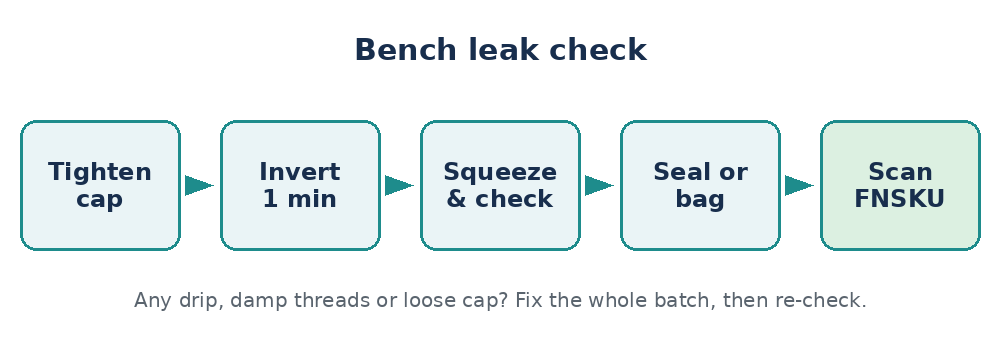
If a unit fails, fix the closure on the whole batch, not just the one you tested.
Get liquids prepped for you
If you'd rather not tape, bag and leak-check every bottle yourself, PrepToShip handles small-batch prep for Amazon FBA and Walmart WFS sellers anywhere in the US and overseas. You get typically 24–48h turnaround and photos at every step, with no monthly minimum on FBA and WFS prep. On your first shipment, labeling fees are waived on the first 100 units (add-ons billed normally). Get a quote.
Know your cost before you ship
Small-batch Amazon FBA and Walmart WFS prep, with no monthly minimum on FBA and WFS prep.
Get a quote